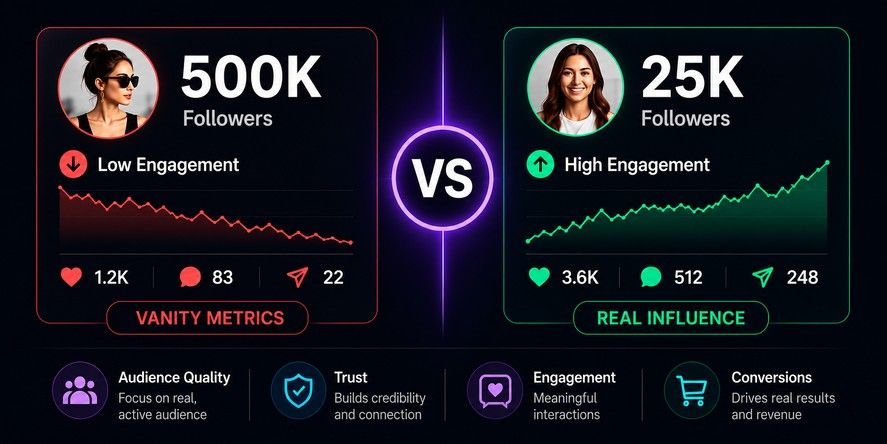
Why Followers Count No Longer Tells the Full Story?
For years, influencer marketing was mostly about one thing: numbers.
If an influencer had a huge Followers Count, brands immediately saw them as valuable. Bigger audience, bigger reach, bigger impact - or at least that’s what everyone believed.
But things don’t work that way anymore.
Over time, brands started noticing something interesting. Some influencers with massive audiences weren’t delivering strong campaign results at all. Meanwhile, smaller creators with far fewer followers were driving better engagement, more trust, and sometimes even more sales.
That completely changed the conversation around influencer marketing.
Today, smart brands are looking beyond surface-level metrics. They want to know whether an influencer actually has influence - not just visibility.
That’s why platforms like CloutScout are becoming more important. Instead of focusing only on follower numbers, brands can dig deeper into audience quality, engagement behavior, and creator performance before investing in campaigns.
Influencer Marketing by the Numbers
- The influencer marketing industry is projected to exceed $30 billion globally in 2025, according to Influencer Marketing Hub.
- Most brands now evaluate influencers using multiple performance indicators rather than follower count alone.
- Engagement quality, audience authenticity, and conversion potential have become key factors in influencer selection.
- Many brands actively screen creator audiences for fake followers and suspicious engagement before launching campaigns.
The Problem with Using Followers Count as the Main Metric
Big Numbers Can Be Misleading
At first glance, an influencer with hundreds of thousands of followers usually feels like a safe bet. The number looks strong, the profile looks influential, and it’s easy to assume the results will match the scale.
But once brands actually run campaigns, the picture can be very different.
Sometimes the engagement is low, conversions don’t happen, and the audience response is weaker than expected. And that’s when it becomes clear: Followers Count doesn’t really explain what’s going on behind the scenes.
It only shows how many people hit “follow” at some point. It doesn’t tell you:
- how active those followers actually are
- whether they still care about the content
- or if they even trust the creator anymore
In reality, there’s a big gap between an audience that simply watches content and an audience that actually reacts to it.
Passive Audiences vs Engaged Communities
Not all audiences behave the same way, and that difference matters a lot for brands.
In simple terms, passive audiences might increase visibility, but engaged communities create real impact.
Because at the end of the day, brands don’t benefit from people who just see content - they benefit from people who actually care about it and respond to it.
And that’s really the core shift in influencer marketing today:
Real influence is built on trust, not just exposure.
Seeing Content Doesn’t Mean People Care
One of the most common mistakes in influencer marketing is confusing visibility with impact.
Today’s audiences are constantly exposed to:
- ads
- sponsored posts
- short-form videos
- endless scrolling content
So even if people see a campaign, it doesn’t automatically mean they remember it, trust it, or act on it.
That’s why some campaigns generate:
- huge reach
- thousands of impressions
- strong visibility
But still produce very weak engagement or conversion results.
Attention alone isn’t enough anymore. What matters is whether the audience actually connects with the content.
Fake Followers and Artificial Growth Are Still Common
Even though influencer marketing has matured, fake growth remains a significant concern for brands.
Industry studies by HypeAuditor have repeatedly shown that influencer audiences can contain varying levels of suspicious, inactive, or low-quality accounts, making audience validation an important step before investing in partnerships.
This is one reason why brands increasingly rely on audience authenticity analysis rather than follower counts alone when evaluating creators.
Bought Followers
Some influencers artificially boost their Followers Count by purchasing fake followers or inactive accounts.
From the outside, the account looks impressive. But once you look deeper, engagement often feels empty.
Artificial Engagement
The same thing can happen with engagement metrics.
Some creators use engagement groups or coordinated activity to increase likes and comments artificially. On paper, it looks strong. In reality, there’s very little genuine interest behind it.
Unnatural Growth Patterns
Sudden spikes in followers, inconsistent engagement, or unusually low interaction compared to audience size are all signs that something may be off.
And for brands, relying only on vanity metrics in these situations can become expensive very quickly.
Followers Count Doesn’t Measure Real Buying Influence
This is where many brands get confused.
An influencer can:
- get millions of views
- create entertaining content
- go viral repeatedly
- attract attention constantly
But that doesn't necessarily mean they can influence buying decisions. Because attention and influence are not the same thing.
There’s a big difference between:
- watching content
- liking content
- trusting the creator
- and actually making a purchase
Followers Count doesn’t tell brands anything about those deeper behaviors.
What Research Shows About Followers Count
Several industry studies have found that audience size alone is a weak predictor of campaign performance.
While larger creators may generate greater reach, factors such as audience relevance, engagement quality, trust, and authenticity often have a stronger relationship with campaign outcomes.
This is why brands increasingly combine follower data with audience analytics when selecting influencers for partnerships.
What Smart Brands Measure Instead of Followers Count
The way brands evaluate influencers today is much more detailed than before.
Instead of focusing on one number, they look at several signals together.
Audience Quality
Brands want to know who’s actually behind the audience.
They ask questions like:
- Are these followers real?
- Are they active?
- Do they fit the target demographic?
- Are they located in the right markets?
Because a large audience means very little if it’s irrelevant.
Engagement Authenticity
Not all engagement carries the same value. A thoughtful comment from a real follower matters far more than dozens of generic reactions.
That’s why brands now pay attention to:
- conversation quality
- audience responsiveness
- consistency of interaction
- long-term engagement patterns
Sometimes smaller influencers outperform larger ones simply because their engagement feels more genuine.
Audience Relevance
Even strong engagement can become useless if the audience doesn’t align with the brand.
For example:
- a beauty brand partnering with an audience mostly interested in gaming
- a regional campaign targeting followers outside the intended market
Relevance plays a huge role in campaign performance.
Content Performance Trends
Brands are also becoming more focused on consistency rather than isolated viral moments.
Instead of asking, “Did one post perform well?” they ask:
- What type of content consistently works?
- Does engagement stay stable over time?
- Which formats perform best?
- How does the creator perform across platforms?
Because one viral post doesn’t always mean long-term influence.
See how these evaluation methods apply when selecting technology creators in our UAE tech influencer guide.
Brand Trust & Credibility
Trust has become one of the most important factors in influencer marketing.
Research from Edelman's Trust Barometer consistently shows that consumers are more likely to act on recommendations from individuals and experts they trust. In influencer marketing, that trust often translates into stronger engagement, higher click-through rates, and better conversion performance compared to creators whose audiences are less connected to their content.
In other words Brands now look closely at:
- how audiences react to sponsored content
- whether followers believe recommendations
- the creator’s long-term credibility
Because without trust, visibility rarely leads to action.
The same principles apply across regional campaigns. Our Saudi influencer marketing playbook explains how brands evaluate creators in the Saudi market.
Conversion Potential
At the end of the day, brands care about outcomes.
Can the influencer generate:
- clicks?
- leads?
- sales?
- Sign-ups?
- real customer interest?
That’s what defines influence today. Not audience size alone.
Why Smart Brands Are Moving Beyond Followers Count
Enterprise Brands
Large companies spend serious money on influencer campaigns, so relying on guesswork is risky.
That’s why enterprise brands invest heavily in:
- audience validation
- fraud detection
- creator analytics
- performance forecasting
They need reliable data before scaling campaigns.
Ecommerce Brands
For ecommerce brands, visibility alone doesn’t mean much. What matters is conversion.
A creator with a smaller but highly engaged audience can often generate more revenue than an influencer with millions of disengaged followers.
SMBs & Startups
Smaller businesses usually don’t have room for wasted budgets. That’s why many startups now prefer micro influencers with:
- niche audiences
- stronger relationships with followers
- higher engagement rates
- more affordable partnerships
The Hidden Cost of Choosing Influencers Based Only on Followers Count
When brands focus only on follower numbers, several problems usually follow:
- wasted marketing spend
- weak campaign performance
- poor audience targeting
- misleading performance reports
- low ROI
- difficulty scaling campaigns confidently
And often, campaigns look far more successful publicly than they actually are behind the scenes.
How CloutScout Helps Brands Measure Real Influence?
Platforms like CloutScout help brands make smarter influencer decisions by offering deeper insights beyond Followers Count.
Brands can:
- review audience quality
- detect fake followers
- compare influencers side by side
- analyze engagement behavior
- validate audience relevance
- make more data-driven campaign decisions
Instead of relying on assumptions, brands get a clearer understanding of who actually has influence.
Followers Count vs Real Influence: The Real Difference
Signs an Influencer Has Real Influence
Sometimes creators with smaller audiences are actually far more impactful because they have:
- loyal followers
- meaningful engagement
- strong niche authority
- authentic audience growth
- high trust levels
- consistent sponsored content performance
Those signals often matter much more than raw audience size.
Why Influencer Marketing Is Becoming More Data-Driven?
According to the Influencer Marketing Benchmark Report published annually by Influencer Marketing Hub, measuring ROI remains one of the top priorities for brands investing in creator partnerships.
As budgets increase, marketers are placing greater emphasis on performance metrics such as engagement quality, audience authenticity, conversions, and campaign attribution.
Influencer marketing is becoming increasingly data-focused because brands are under more pressure to prove results.
Campaign costs are rising. Competition is stronger than ever. And companies want measurable ROI before investing larger budgets.
That’s why modern influencer marketing is shifting away from vanity metrics and toward performance-based decision-making.
FAQ About Followers Count
1. Does a higher Followers Count always lead to better campaign results?
Not necessarily. A large audience may increase visibility, but it doesn’t guarantee trust, engagement, or conversions. Many smaller creators with highly engaged audiences often deliver better results than influencers with millions of passive followers.
2. Why are brands paying less attention to Followers Count today?
Because brands have realized that audience size alone doesn’t reflect real influence. They now care more about audience quality, authenticity, engagement behavior, and whether an influencer can actually drive action.
3. Can influencers fake their Followers Count?
Yes. Some creators buy fake followers or use artificial engagement tactics to make their accounts appear more influential than they really are. That’s why brands now rely on deeper analytics instead of surface-level numbers alone.
4. What matters more than Followers Count in influencer marketing?
Things like:
- audience relevance
- engagement quality
- trust
- authenticity
- conversion potential
These factors usually say much more about an influencer’s real impact than follower numbers alone.
5. Why do smaller influencers sometimes outperform larger creators?
Smaller influencers often have more engaged communities and stronger relationships with their audiences. Their followers tend to trust recommendations more, which can lead to higher engagement and better conversion rates.
According to Influencer Marketing Hub benchmark research, engagement rates generally decline as follower counts increase. Nano and micro influencers frequently achieve higher engagement percentages than larger creator accounts, making them attractive partners for brands focused on audience interaction and conversions.
6. How do brands know if an influencer has fake followers?
Brands usually look for warning signs such as:
- sudden follower spikes
- unusually low engagement
- repetitive or generic comments
- inconsistent audience behavior
Platforms like CloutScout also help brands analyze audience authenticity more accurately.
7. What is audience authenticity?
Audience authenticity refers to how real, active, and relevant an influencer’s followers actually are. An authentic audience consists of genuine people who regularly engage with content-not bots or inactive accounts.
8. Why is engagement quality more important than reach?
Because real engagement shows that people are actually paying attention. Meaningful comments, conversations, saves, and shares often indicate stronger audience trust than simple views or impressions.
9. What do smart brands look for before choosing an influencer?
Today, brands usually evaluate:
- audience quality
- engagement authenticity
- audience relevance
- creator credibility
- conversion potential
- long-term performance trends
Instead of asking “How many followers does this creator have?”, smart brands now ask, “Can this creator actually influence decisions?”
Stop Chasing Followers Count. Start Measuring Real Influence.
The influencer marketing industry has changed a lot.
Today, the smartest brands focus less on vanity metrics and more on what actually drives results:
- trust
- audience quality
- relevance
- engagement
- conversion potential
-
Because real influence is about impact, not just exposure.
Across thousands of influencer profiles analyzed through CloutScout, audience authenticity and engagement consistency were significantly stronger indicators of creator quality than follower count alone.
With tools like CloutScout, brands can make more confident decisions, reduce wasted spend, and build campaigns based on real audience insights instead of assumptions.
Learn how these metrics are applied when selecting influencers for digital marketing campaigns in Dubai.
In the end, Followers Count is just a number. Real influence is what truly matters.